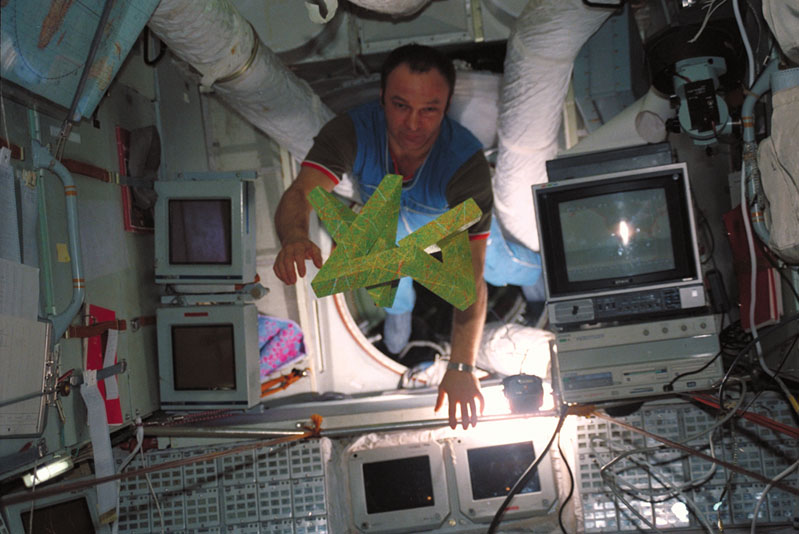
cosmic dancer - a space art intervention by arthur woods

Art in Space
Astronautical Art
One of the early modern practitioners of an astronautical approach to space and art was artist Frank Malina who was also a pioneering space engineer and was co-founder of both the Jet Propulsion Laboratory in the 1940’s and the International Academy of Astronautics in 1959 as well as being the founder of Leonardo – the academic journal on art, science and technology in 1968. His innovative kinetic artworks created in the 1950’s and 60’s often incorporated both astronomical and astronautical concepts and elements.
Thus the advent of spaceflight marks the beginning of the genre of astronautical art. Since then, artists began to initiate projects to explore outer space on their own artistic terms by proposing art concepts designed to be realized in the outer space environment, by utilizing space technologies and materials for their artistic purposes or with their own bodies and projects in micro-gravity or Zero-G environments. A few artists have also been astronauts and created artworks while in space.
Astronautical art has several broad categories.
- Art that depicts space hardware and/or spaceflight.
- Art designed for realization in the outer space environment.
- Art on Earth that is viewed from space.
- Art that is made in space.
- Art that is designed for space habitats.
- Art that is attached to space hardware such as rocket launchers and satellites.
- Art that relies on space technologies and/or materials for its realization.
- Performance art, either in space or in a simulated micro-gravity environment.
For a comprehensive overview of astronautical arts please see:
Art to the Stars
An Astronautical Perspective on the Arts and Space



